When pilots buy an aircraft together, most of the attention goes to the aircraft itself: the purchase price, the model, expected annual hours, maintenance condition and operating costs.
Those questions matter, but they are not usually where co-ownership fails. The more difficult problems often appear later, when the group has not clearly agreed who owns what, who decides what, who pays for unexpected costs and how a member can leave.
The ownership structure is therefore not just an administrative detail. It determines who legally owns the aircraft, how decisions are made, how liability is allocated, what happens if one member stops paying, and whether the group can survive a serious disagreement.
There is no single structure that is always best. Each option solves some problems and creates others. The right choice depends on the number of pilots, the level of trust between them, the expected use of the aircraft, tax and financing considerations, and how much control each member should have.
In a direct personal co-ownership, each pilot owns a percentage of the aircraft personally. For example, one pilot may own 50%, another 30% and another 20%.
This is simple and relatively easy to understand. It may work well for two people who know each other, trust each other and have a clear written agreement.
The weakness is that every owner is directly connected to the aircraft and to the other owners. If one member dies, divorces, becomes insolvent, stops paying or wants to sell, the whole group may be affected.
In some groups, only one person legally owns the aircraft, while the other pilots contribute money and use the aircraft as if they were co-owners.
This can feel practical at the beginning because the aircraft remains in one name and the group avoids a more formal structure.
The risk is that the non-owning participants may have limited protection. If the legal owner sells the aircraft, changes their mind, becomes insolvent or dies, the other participants may struggle to prove what rights they actually have.
Another option is to create a partnership or contractual group. The aircraft is then held or operated through a defined group arrangement rather than by completely informal cooperation.
This can provide more structure than informal participation, but it does not automatically remove personal liability or practical disputes.
The main risk is that the partnership agreement may be too general. If voting rights, cost sharing, exit rights, maintenance decisions and member obligations are not clearly drafted, the partnership can become difficult to manage.
Some groups create a limited company or special purpose vehicle. The company owns the aircraft, and the pilots own shares in the company.
This often looks professional and can make ownership transfers, governance and liability management easier if designed properly.
However, a company does not solve co-ownership problems by itself. If the shareholders’ agreement, voting rules and exit mechanisms are weak, the same disputes simply move into a more formal structure.
In a club or association model, the pilots may not own the aircraft directly. Instead, they become members and receive a right to use the aircraft under the club’s rules.
This can reduce the need for individual ownership decisions, but it also means that members may have less control over the aircraft, future costs, booking priority and long-term planning.
A professionally managed or fractional structure gives pilots a defined share or right of use while a manager handles many practical matters.
This can reduce operational friction, especially where participants want access without managing every detail themselves.
The main risk is dependence on the manager. The participant must understand the management fees, resale rights, usage restrictions, valuation mechanism and what happens if the manager fails or changes the rules.
The best structure is not necessarily the simplest one. It is the structure that still works when something goes wrong.
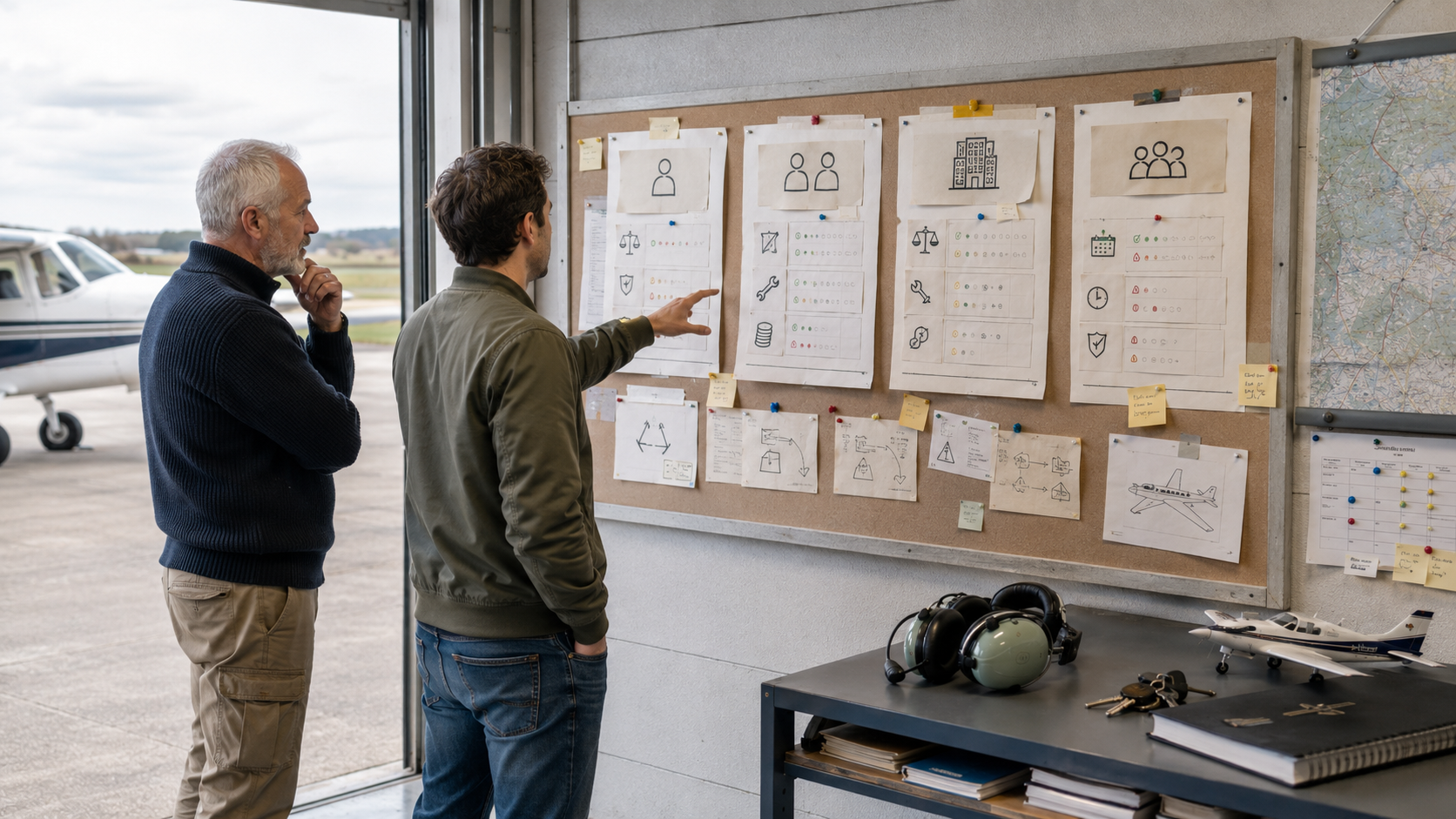
Before choosing a model, the group should test the structure against realistic scenarios: one pilot wants to leave, another stops paying, the aircraft needs a major repair, the group disagrees about upgrades, or a member wants to sell their share.
If the answer is unclear, the structure is probably incomplete.
A good co-ownership structure should deal with at least the following issues:
Most aircraft co-ownership arrangements work well on the best day: everyone is enthusiastic, the aircraft is available, and costs are expected.
The real test is the worst day: a major repair, a payment default, a dispute about use, or a member who wants to exit immediately.
The strongest co-ownership structures do not assume that nothing will go wrong. They assume that problems may arise and make those problems manageable before they become expensive disputes.
Before committing to an aircraft group, pilots should therefore review not only the aircraft, but also the ownership structure, agreement, reserve model and exit mechanism.
Invictum Aero can help assess which structure is most suitable for your planned aircraft group and whether the key risks have been addressed before you commit.