Financing changes the whole transaction
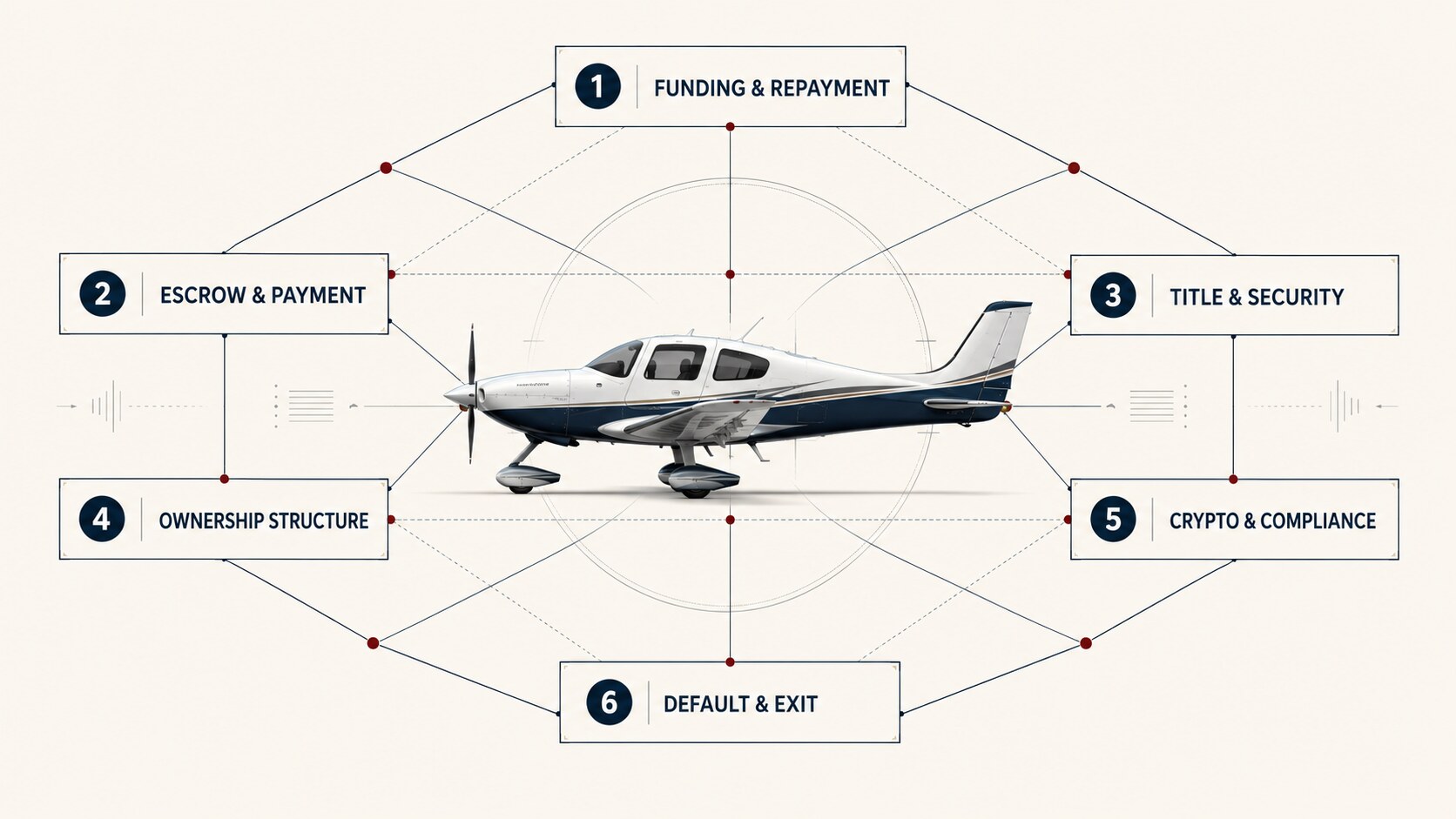
An aircraft loan or bank financing provides funds for the purchase against repayment obligations and usually lender security. It is often approached as a simple question: how much will the bank lend, what deposit is required and what interest rate will apply?
In reality, the financing structure can determine who owns the aircraft, where it may be registered, how it can be used, which insurance is required and what happens if the borrower defaults. It may also affect VAT treatment, maintenance decisions, resale and the ability to bring another owner into the structure.
The lowest interest rate does not necessarily produce the lowest-risk structure. A financing arrangement must work together with the purchase agreement, ownership model, registration, insurance and intended operation of the aircraft.
Bank approval does not remove transaction risk
A lender’s approval confirms that it is prepared to finance the transaction on specified terms. It does not confirm that the aircraft is technically suitable, that the seller has clear title or that the proposed ownership structure is legally and commercially appropriate.
Conditions precedent to funding are the documents, approvals and other requirements that must be satisfied before the lender releases money. A personal guarantee makes an individual responsible for defined borrower obligations and can extend exposure beyond the aircraft itself.
The financing documents may also include obligations extending far beyond repayment of the loan:
- Personal guarantees from the owner or shareholders
- Restrictions on registration, location or use of the aircraft
- Mandatory insurance conditions and lender endorsements
- Requirements concerning maintenance and continuing airworthiness
- Limits on leasing, sharing or permitting third-party use
- Financial reporting and valuation requirements
- Early repayment costs or a large final balloon payment
- Default rights triggered by breaches unrelated to missed payments
A further risk appears when the purchase agreement requires a deposit or completion by a fixed date, but the bank has not yet completed its valuation, documentation or security requirements. The buyer may then have financing in principle but still be unable to complete the transaction.
Financing conditions should therefore be aligned with the purchase agreement before a substantial deposit becomes non-refundable.
Escrow protects only what the instructions cover
Aircraft purchase escrow places the purchase funds with an independent third party and releases them only when agreed closing conditions have been satisfied. It can reduce payment and closing risk when the instructions are complete.
However, escrow is not a form of financing and it does not replace due diligence. Its protection depends entirely on the quality of the escrow instructions.
The instructions should clearly define:
- Which documents must be delivered before funds are released
- Whether title and security searches must be completed
- How existing loans, mortgages or other interests will be discharged
- When the aircraft is accepted and when possession transfers
- Who confirms registration or deregistration requirements
- When insurance must become effective
- Who bears currency-conversion costs, bank charges and taxes
- What happens if a condition is not satisfied before the closing deadline
An escrow agent normally performs the tasks assigned in the instructions. The agent may not independently verify technical condition, authority to sign, tax treatment or the absence of every possible claim against the aircraft unless expressly required to do so.
Even a professionally operated escrow can therefore release funds correctly under incomplete instructions. The escrow arrangements, purchase agreement and financing conditions must be designed as one coordinated closing process.
Special-purpose vehicles require proper structuring
A special-purpose ownership or financing vehicle is a company established to acquire, hold or finance the aircraft separately from the individuals using it. This can be useful, particularly where several investors participate or the aircraft will be operated across borders.
But forming a company does not itself create a safe structure. It introduces additional questions:
- Is the capital provided as equity or shareholder debt?
- Who controls the company and its bank accounts?
- Who is responsible for loan payments and maintenance reserves?
- Can the lender take security over the aircraft, company shares or accounts?
- Are personal or corporate guarantees required?
- How are private use, business use and third-party payments treated?
- What happens if an investor stops contributing?
- How can the aircraft or the company be sold?
- What happens if the vehicle or one of its owners becomes insolvent?
The structure must also be consistent with company law, aviation registration rules, tax residence, VAT treatment and the actual operation of the aircraft.
A special-purpose vehicle is a tool. It does not replace the legal, financial and operational design around the transaction.
Title and security must be checked
Title transfer is the legal change of ownership from seller to buyer. Lender security—such as an aircraft mortgage, pledge or charge—is the right created to protect the financier and support enforcement if the borrower defaults.
The aircraft register may identify the registered operator or owner, but depending on the jurisdiction it may not provide a complete picture of title, financing interests or other claims affecting the aircraft.
A transaction may require checks covering:
- The seller’s legal ownership and authority to sell
- Aircraft mortgages, pledges or other registered security
- Corporate charges affecting the seller or ownership vehicle
- Existing bank financing and repayment arrangements
- Maintenance, storage, tax or other claims that may affect release
- Insolvency proceedings involving the owner
- Deregistration and export requirements
- Original records, logbooks and technical documentation
- The correct discharge and registration of security at closing
For aircraft and engines falling within its scope, the Cape Town Convention and International Registry may also be relevant. Many smaller general-aviation aircraft do not fall within that system, and national law may remain decisive.
The correct searches and registrations therefore depend on the aircraft, the parties and the relevant jurisdictions. Paying the seller does not by itself ensure that every existing right has been discharged or that the financier’s new security has been properly created.
Crypto assets create additional execution risks
Crypto assets, including USDT where accepted by the parties and service providers, may be used as a source of purchase funds or as a means of settlement. They are not, by themselves, a financing structure.
Source-of-funds and anti-money-laundering checks require the parties and regulated service providers to understand and document where the purchase money originated and how it reached the closing. Wallet history alone may not satisfy every bank, lender or escrow provider.
A crypto-funded transaction introduces additional issues that should be resolved before the purchase agreement is signed:
- In which currency is the aircraft price legally denominated?
- Which crypto asset, wallet and blockchain network will be used?
- At what moment is the exchange rate fixed?
- Who bears volatility, conversion costs and network fees?
- How many confirmations are required before payment is final?
- What happens if a transfer is delayed or sent incorrectly?
- How will ownership and source of funds be documented?
- Will the seller’s bank, lender and escrow provider accept the arrangement?
- Does conversion or transfer create a taxable event?
- How will a refund be made if the transaction does not complete?
Banks, escrow providers and other professional parties may require enhanced source-of-funds checks or may decline to participate in a crypto-funded closing. Transfers involving regulated crypto-asset service providers may also require information about the originator and beneficiary.
Even where buyer and seller are comfortable with crypto, the wider transaction infrastructure may not be. The payment route should therefore be tested and accepted by all relevant parties before funds or a deposit are committed.
A dry lease may be the better capital decision
Financing ownership is not always the best solution. A private dry lease is medium-term aircraft access without crew: where the intended period of use is 12–24 months or the pilot does not want to commit substantial capital, it may provide dedicated access without purchasing the aircraft.
This does not eliminate risk. The lease must still address matters such as:
For a pilot-facing explanation of the model, see our 12–24 month private aircraft dry lease.
- Security deposits and advance payments
- Insurance and permitted pilots
- Maintenance and continuing-airworthiness responsibilities
- Maintenance reserves
- Aircraft availability and downtime
- Geographic and operational restrictions
- Damage and deductibles
- Early termination
- Return condition and end-of-lease inspections
The comparison should not be limited to the monthly loan instalment versus monthly rent. It should consider total capital committed, operational responsibility, residual-value exposure, flexibility and the cost of exiting the arrangement.
For some pilots, ownership creates the right long-term platform. For others, a structured dry lease may provide the required access with less capital exposure.
Coordinate the structure before committing
Aircraft financing rarely sits within one professional discipline. The transaction may require coordinated input from an aviation lawyer, lender, tax adviser, insurer, technical inspector, registry specialist and escrow provider.
The greatest risk is often not that one document is missing. It is that each part of the transaction was prepared separately and the documents do not work together.
Before signing or paying a substantial deposit, the structure should answer:
- Who will own, finance and operate the aircraft?
- Where will it be registered?
- What security will be created and where must it be registered?
- What conditions must be satisfied before money is released?
- When do title, possession and risk transfer?
- How are VAT, taxes and source of funds addressed?
- What happens following default, damage or early exit?
- Can the structure still work if the aircraft must be sold?
An aircraft transaction specialist does not make financing more complicated. The specialist’s role is to identify and coordinate these issues before they become expensive closing problems.
Default, enforcement and exit should be examined together: default identifies the breach, enforcement determines what the lender or other party may do, and exit addresses repayment, sale, transfer or restructuring when the arrangement must end.
Structure first. Aircraft second.
This briefing provides general information and is not legal, tax, financial or transaction-specific advice. The appropriate financing and ownership structure depends on the aircraft, participants, intended use and relevant jurisdictions. Professional advice should be obtained before entering into a transaction.