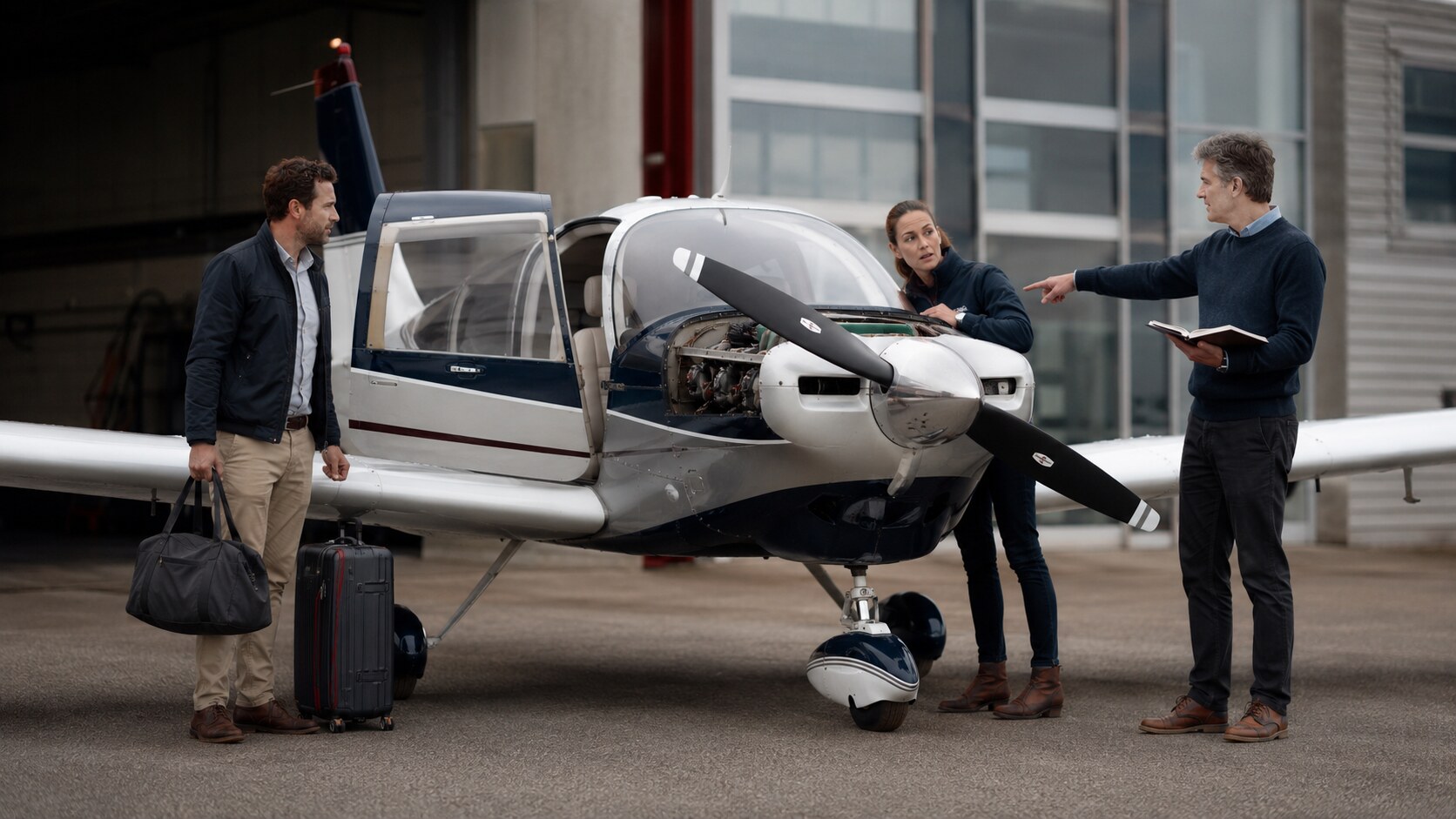
Why pilots start thinking about ownership
For many private pilots, the question of aircraft ownership does not begin with a desire to become an aircraft owner. It begins when renting starts to feel limiting. You may be flying more frequently, finding that the aircraft you want is unavailable, or discovering that weekend and multi-day trips are difficult to arrange.
Consistency also matters. Flying the same aircraft builds familiarity with its avionics, loading, performance and small operational characteristics. A pilot moving beyond local training flights may want a touring aircraft with better speed, payload, range, equipment or comfort than a flight school or flying club can reliably provide.
At that point rental can feel temporary, but dissatisfaction with rental does not prove that buying is the correct next step. A different club, a better rental provider, co-ownership, an aircraft syndicate or a medium-term private aircraft dry lease may solve the real access problem with a different level of commitment.
How many hours per year justify aircraft ownership?
There is no universal break-even number of annual flight hours. Any calculation depends on the aircraft, its condition and value, where it is based, how it is financed and the missions it performs. A figure quoted by another owner may be irrelevant to a different aircraft or country.
Ownership combines variable costs with fixed costs that continue even when the aircraft is not flying. Hangarage, insurance, annual inspections, continuing-airworthiness administration, subscriptions and some maintenance remain payable at low utilisation. Engine and propeller reserves, fuel and wear rise with use. Financing costs, depreciation and the opportunity cost of capital tied up in the aircraft belong in the comparison as well.
Higher utilisation spreads fixed costs across more hours, but does not by itself make ownership rational. Illustrative cost models should be treated as scenarios, not universal thresholds: one unexpected repair, a different insurance requirement or a more expensive base airport can materially alter the result. The honest input is the number of hours you will realistically fly—not the hours needed to justify a purchase already desired.
Ownership is not only an hourly-cost calculation
An aircraft owner buys control as well as flight time. The aircraft can be available for spontaneous flying and multi-day travel; equipment may remain on board; avionics become familiar; and the owner can choose its base, maintenance approach and upgrades. Those benefits can have real value even when the calculated hourly cost exceeds rental.
The opposite conclusion can be equally rational. A pilot mainly interested in economical local flying, who can accept booking constraints and several aircraft, may obtain little value from control. Rental or a flying club transfers much of the fixed-cost, downtime and resale exposure to somebody else.
The comparison should therefore assign value to availability and control without pretending they are free. A higher-cost decision can be rational when it buys capabilities the pilot actually uses; a superficially low hourly ownership estimate is not rational if it ignores capital, downtime or unrealistic utilisation.
What if you are not sure which aircraft you actually need?
Mission uncertainty is a strong reason to slow the purchase decision. A pilot may expect to need a four-seat touring aircraft but later discover that most flights carry one passenger, or that luggage, grass-strip capability, IFR equipment, range or payload matters more than speed.
Local recreational flying and European touring create different requirements. So do VFR and IFR operations, two-seat and four-seat use, short runways, family trips and regular baggage. The intended base, maintenance support and insurance eligibility can make an attractive model impractical.
Buying the wrong aircraft can be substantially more expensive than postponing the purchase because changing aircraft adds transaction costs, maintenance uncertainty and resale exposure. An independent mission assessment should start with actual trips, occupants, payload, annual hours and likely changes over several years. Invictum Aero’s Aircraft Check can add preliminary fleet and market context, while the Ownership Advisory process considers the broader aircraft and ownership model.
If a particular model is already under consideration, request an Aircraft Check, or review independent Ownership Advisory before committing.
What alternatives are there between hourly rental and owning the whole aircraft?
Explore the practical differences in our pages on private dry lease, structured co-ownership and ownership advisory.
Conventional rental or flying club
This is often best where low commitment and flexibility matter more than dedicated availability. The operator carries ownership exposure, while the pilot accepts shared schedules, operating rules and the available fleet.
Co-ownership or aircraft syndicate
Two or more pilots can distribute acquisition and fixed costs while preserving ownership rights. It works best when missions, utilisation and maintenance expectations are compatible and governance, scheduling, funding and exit are documented before purchase.
Private aircraft dry lease
A qualified pilot or small pilot group leases a specified aircraft without crew for a medium-term period, typically 12–24 months. It can provide more dedicated access than hourly rental without aircraft acquisition, but it remains a meaningful financial and operational commitment—not casual rental.
Full ownership
Full ownership provides maximum control and can fit a stable long-term mission. The owner also carries the full capital requirement, fixed and operating costs, decision burden and residual-value exposure.
European context matters
This framework is written primarily for European private general aviation. Registration, tax and VAT treatment, insurance, maintenance arrangements, ownership structures and financing can differ materially between Germany, Austria, Switzerland, the United Kingdom and other European jurisdictions.
Country-specific issues should be checked with the relevant qualified specialists. Invictum Aero works across Europe and can help identify and coordinate jurisdiction-specific legal, tax, VAT, registration, financing, insurance or technical input without presenting one country’s answer as universally applicable.
Ask a different question
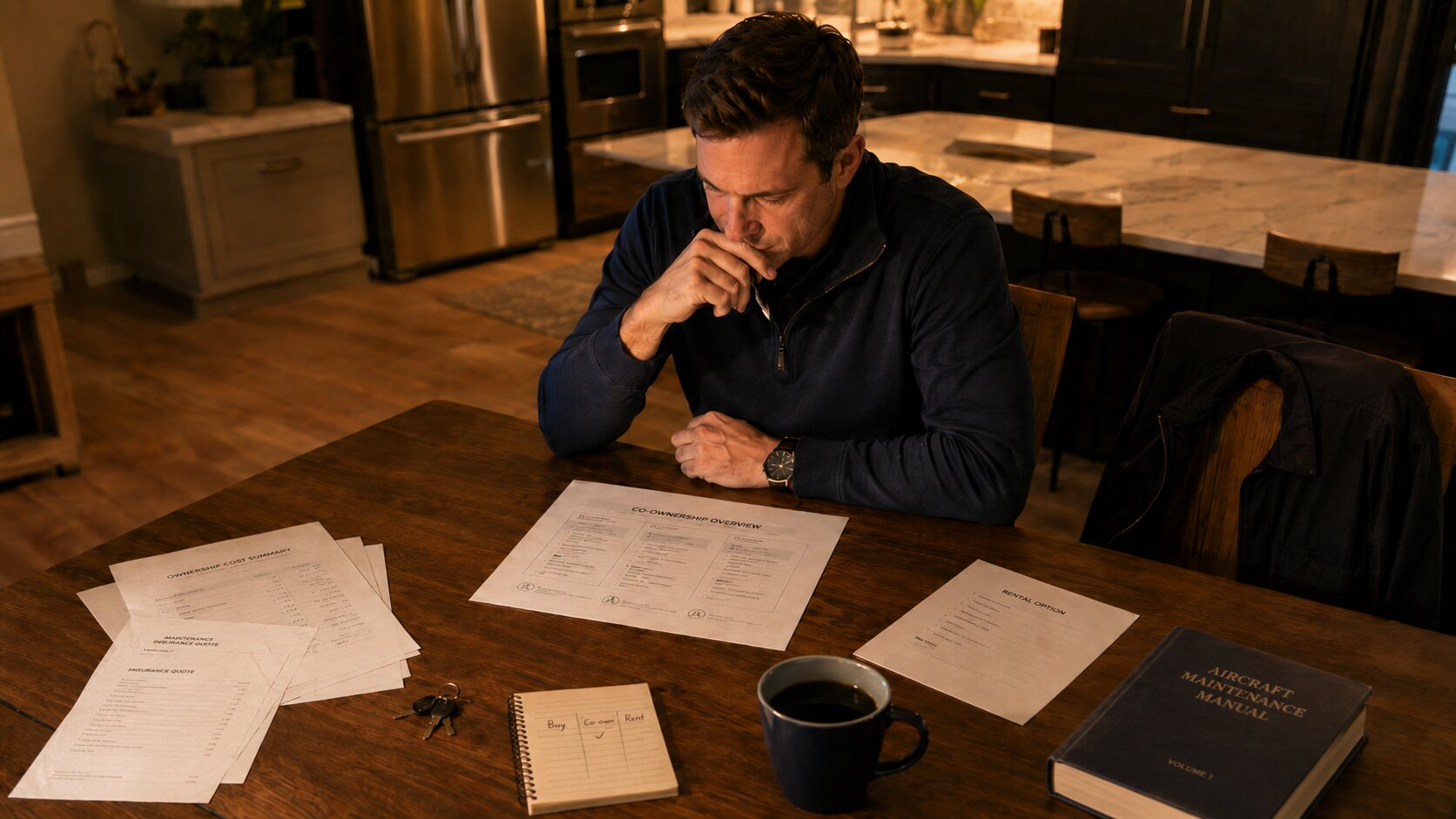
Instead of asking only, ‘Is owning cheaper than renting?’, ask: ‘What level of aircraft access, control, financial commitment and flexibility fits the way I actually fly?’ The answer may be to continue renting, join a club, buy with other pilots, lease a specified aircraft, buy outright or postpone the decision.
Rental offers low commitment but shared availability. A dry lease offers more dedicated medium-term access without acquisition. Co-ownership distributes capital and fixed costs but adds shared governance. Full ownership offers maximum control with maximum long-term exposure. The rational choice is the one whose benefits and obligations match the pilot’s actual mission.
| Model | Access | Capital and commitment | Main trade-off |
|---|---|---|---|
| Rental / club | Shared and booking-dependent | Low | Limited scheduling and aircraft control |
| Private dry lease | Specified aircraft for 12–24 months | Medium contractual commitment | Operating responsibilities without ownership |
| Co-ownership | Shared under agreed rules | Shared purchase capital | Governance, compatibility and exit |
| Full ownership | Maximum control | Full capital and long-term exposure | All cost, decision and resale responsibility |
This briefing provides general information and is not legal, tax or transaction-specific advice. The appropriate structure depends on the aircraft, participants and relevant jurisdiction.