The purchase price is only the starting point
Buying an aircraft is easy to understand conceptually: find the aircraft, agree the price and complete the acquisition. Owning one is different. The purchase price is only one part of responsibility for an asset requiring maintenance, insurance, hangarage, compliance, periodic investment and eventually resale.
The acquisition commits capital that could otherwise remain available. Financing can reduce the initial cash requirement but adds interest, security, covenants and repayment obligations. The transaction may also involve inspection, travel, escrow, professional advice, registration and delivery costs.
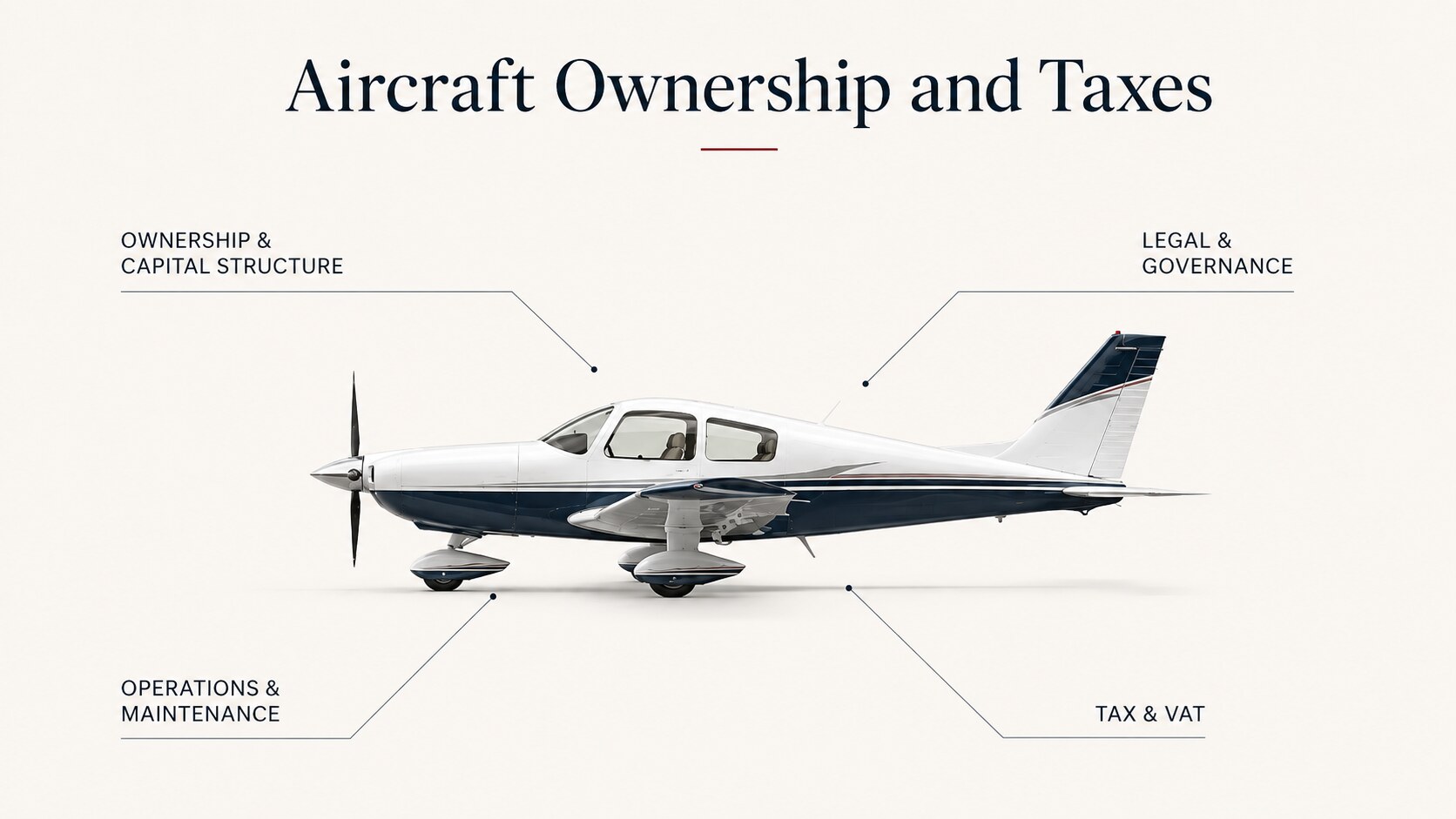
Tax and VAT treatment depends on jurisdiction, ownership, prior VAT history and actual use; company ownership does not automatically make private flying tax-efficient. These points should be examined before signing or paying a non-refundable deposit, with the relevant local specialists where necessary.
For the principal issues, see Aircraft Ownership and Taxes.
What costs continue when an aircraft is not flying?
Hangarage, insurance, annual inspection, navigation or database subscriptions, continuing-airworthiness requirements and recurring administration do not disappear because weather, maintenance or personal circumstances reduce flying. Some calendar-limited components also become due regardless of hours.
This is why annual utilisation matters. With few annual flight hours, each hour carries a larger share of fixed costs. With more hours, fixed costs are spread more widely, but fuel, wear and hour-based maintenance increase. Neither calculation should ignore downtime.
The correct budget is aircraft- and location-specific. Insurance for a pilot and model, hangar costs at the intended base airport, the applicable maintenance regime and the aircraft’s actual status are more useful than a universal internet estimate.
Maintenance is not completely predictable
Planned maintenance includes annual inspections, scheduled tasks and replacement of life- or calendar-limited components. Reserves for engines and propellers can make future expenditure visible, but a reserve is a budgeting device, not a guarantee that the next invoice will match the forecast.
Unscheduled defects, corrosion, wear, parts availability, avionics failures and findings discovered during inspection can create additional expense and downtime. An apparently inexpensive aircraft can require substantial investment when maintenance history, equipment age or deferred work is examined properly.
Owners also decide whether to repair, replace or upgrade. A new radio, transponder, autopilot or panel may improve utility and value, but the owner chooses when to invest and carries the risk that the market will not repay the full cost on resale.
Ownership also requires decisions and time
An owner selects maintenance providers, plans inspections, responds to defects, renews insurance, secures hangarage, protects records and decides on upgrades. When the aircraft cannot fly, somebody must coordinate the solution rather than simply book another rental aircraft.
Good records are operationally and commercially important. Missing or disorganised documentation can complicate airworthiness review, maintenance planning, financing, insurance and later resale. Cross-border operation can add registration, tax or support questions.
For many pilots this control is part of the attraction. They value knowing who maintains the aircraft, why work was done and how it is equipped. The question is not whether these responsibilities are inherently negative, but whether the prospective owner wants to carry them.
Your requirements may change before the aircraft does
The aircraft may remain serviceable for decades while the owner’s mission changes within a few years. Family circumstances, increasing experience, an IFR qualification, relocation, a different base airport or changed annual flying can alter what is useful.
A two-seat aircraft may no longer carry the required passengers and baggage. A touring aircraft may be unnecessarily expensive for local flying. More speed, range, payload, short-field performance or weather capability may become important—or turn out not to be used.
The acquisition decision should therefore test the likely mission over the intended holding period, not only today’s preferred model. Where uncertainty is high, delaying, renting, co-owning or using a medium-term lease can preserve flexibility while the real mission becomes clearer.
A free Aircraft Check can provide preliminary context for a specific aircraft; Ownership Advisory addresses the wider mission and structure.
Eventually you have to exit
Aircraft ownership ends through resale, transfer, trade-in, restructuring or, sometimes, a prolonged period in which the aircraft is marketed but not sold. Market conditions, location, records, condition, maintenance status, engine time and avionics all affect buyer interest and value.
Selling takes time and may involve inspection, defect negotiations, brokerage, legal documentation, deregistration or export, taxes and delivery. An owner who must sell quickly may accept a different result from one able to wait for a suitable buyer.
The purchase decision should therefore include an exit hypothesis: the expected holding period, likely buyer, work required before sale and the effect of maintenance cycles on value. Residual value is exposure, not a guaranteed repayment of purchase capital.
European ownership requires local context
For European private pilots, registration eligibility, tax and VAT, insurance, maintenance oversight, financing and ownership structures vary by country and by where the aircraft is based and used. Germany, Austria, Switzerland and the United Kingdom do not share one identical legal or tax framework.
Invictum Aero can coordinate the commercial and structural assessment across Europe and identify where jurisdiction-specific legal, tax, registration, financing, insurance or technical advice is required. The local regulated conclusion must come from the appropriate specialist.
Ownership can still be the right answer
For a pilot who expects long-term use, understands the required aircraft, values maximum control and accepts the practical and financial responsibilities, full ownership may be entirely rational. The work of ownership can be rewarding, and consistent access may materially improve the kind of flying possible.
For others, conventional rental, a flying club, an aircraft syndicate or Haltergemeinschaft, structured co-ownership, or a private dry lease can provide a better balance. These models do not remove all responsibilities; they distribute capital, control, availability and exposure differently.
The relevant question is not simply, ‘Can I afford to buy the aircraft?’ It is: ‘Do I want the capital commitment, responsibility and long-term exposure that comes with owning this particular aircraft?’
Compare the alternatives through Ownership Advisory, structured co-ownership and private dry lease.
This briefing provides general information and is not legal, tax or transaction-specific advice. The appropriate structure depends on the aircraft, participants and relevant jurisdiction.